

April Teaching Planner
Updated: Sep 10

Teaching ideas, activities, and inspiration for sensory learners of all ages to celebrate the month of April, including St George's Day, Vaisakhi, Shakespeare Day, Earth Day, World Art Day, National Superhero Day, National Tea Day and more...
Dates at a Glance
Apr 3 - Find a Rainbow Day
Apr 5 - Easter
Apr 7 - World Health Day
Apr 13 - Vaisakhi
Apr 15 - World Art Day
Apr 21 - National Tea Day
Apr 22 - Earth Day
Apr 23 - St Georges Day
Apr 23 - Shakespeare Day
Apr 25 - World Penguin Day
Apr 28 - National Superhero Day
Apr 3
Find a Rainbow Day
Rainbows End Treasure Hunt
This activity promotes problem solving skills and physical development.
Hide multicoloured 'treasure' items around the room, garden, or outdoor area: acrylic gems, baubles, buttons, coloured clothing pegs, costume jewellery, Lego/Duplo bricks, fabric & material, pom poms, ribbon, tinsel.
Provide clues to help students to locate the treasure. This can be done verbally, through the 'hot' and 'cold' game, riddles, visual clues or provide a map.
Provide a box or bag for the sensory explorer to store their discovered treasure as they find it.
Alternatively provide a tick list or create a laminated visual board for the sensory explorer to tick off or circle as the treasure is found.

Alternative Treasure Hunt Activity
Place multicoloured 'treasure' inside a box of coloured shredded paper.
Can the student(s) use their sense of touch to find the items?
Provide a torch to explore how the treasure sparkles and reflects in the light.
Explore a Kaleidoscope.
Can the student(s) rotate the dial independently and watch the images and patterns created as the colourful beads, feathers and small pieces of glass rotate?
Colour Sorting Game
Develop fine motor skills and colour recognition
Can the sensory explorer use safety tweezers/chopsticks/their fingers and thumbs to pick up coloured buttons, Lego bricks, pom poms, gems, and rainbow drops?
Can the sensory explorer sort items of the same colour into boxes/baskets.
Rainbow Sensory Umbrella
Thread the ribs of an umbrella with multicoloured LED battery lights (tape the battery pack to the handle of the umbrella)
Tie colourful ribbons, streamers, and mirrors (to reflect the colours) to the ribs of the umbrella.
Rotate.
Apr 5 - Easter
Palm Sunday – Sensory Palm Waving & Crowd Re enactment
Activity Outline
Explore the Palm Sunday moment when crowds welcomed Jesus by waving branches. The activity uses sensory props, movement, sound, and group participation to recreate the feeling of a joyful crowd. Learners can make or decorate simple palm style items, wave them, feel their textures, and take part in a gentle re enactment of the crowd welcoming Jesus.
Learning Objectives
Explore textures, movement, and sound through palm style props.
Experience waving, brushing, tapping, or holding sensory materials.
Respond to visual movement, air ow, and rustling sounds.
Participate in a shared group moment representing a crowd.
Experience anticipation, excitement, and togetherness.
Observe or join in with waving, cheering, or gentle movement.
Show preferences through gesture, expression, or vocalisation.
Palm Style Prop Ideas
Ribbon palms - green ribbons tied to a wooden spoon, dowel, or cardboard tube.
Paper or card palms - add texture using corrugated card, bubble wrap, or tissue paper. Fabric Palms
Herbs such as rosemary for scent exploration.
Facilitation Guidance
Re-enacting the Crowd Setting the Scene
Invite the learners to gather in a semi circle. Invite each learner to choose a palm style prop to explore. Use gentle drumming, clapping, or recorded crowd ambience.
Group Re-enactment
Wave the palms slowly, then faster.
Move the palms high, low, side to side.
Create a “path” for 'donkey' prop to walk through or recreate the sound of donkey hooves using blocks and beaters or coconut shells.
Invite learners to wave as the “Jesus figure” passes by. Celebrate every response, however small.
Optional Add Ons
Use a large piece of green fabric as a shared “crowd wave” moment. Add gentle percussion (shakers, tambourines). Invite learners to place palms on the floor to create a “path”.

This resource has been created to support inclusive, multisensory engagement, inviting learners to explore the Easter Story through the senses as they follow the Easter journey in the order it unfolds, beginning with Palm Sunday as Jesus enters Jerusalem, moving onto the Last Supper, the quiet moments in the Garden, and the events of Good Friday. The story continues with Jesus being placed in the Tomb, discovery of the Empty Tomb and the Resurrection concluding with sharing the message of light and love at the heart of Easter.
Sensory-rich activities that complement the story include a Palm Sunday Palm Waving Re-enactment, Last Supper Sensory Food tasting and Shared Meal, Light of Jesus Sensory Artwork, Sensory Foot-Spa Washing the Disciples' Feet and Sensory Easter Egg Exploration.
Rooted in a commitment to accessibility, sensory engagement and meaningful communication, each couplet offers a sensory prompt guiding the story explorer through a journey where they can explore and connect in a space where every sense is welcome.
Apr 7
World Health Day
World Health Day is dedicated to promoting the benefits of good health and wellbeing.
The theme for 2026 is “Together for health. Stand with science.”
Breathing Bubbles: A Calm Science Activity
How This Links to World Health Day 2026
The 2026 World Health Day theme, “Together for health. Stand with science,” celebrates simple scientific ideas that help us understand our bodies and the world around us.
Bubbles offer an accessible way for PMLD learners to explore science through breath, movement, light, and cause‑and‑effect.
This activity shows how our breath can create change, how bubbles form and float, and how tools like bubble machines help us explore science together. It supports wellbeing, calm regulation, and shared moments of joy — all rooted in gentle, meaningful science.
Activity Outline
Learners are invited to explore bubbles using different tools — bubble wands, pot bubbles, large wands, and a switch‑activated bubble machine. They experience big and small bubbles, slow and fast bubbles, and bubbles created through breath or mechanical movement. The activity encourages visual tracking, anticipation, choice‑making, and calm sensory engagement.
Learning Objectives
To explore cause‑and‑effect through bubble creation
To develop breath awareness (long blow, short blow) where appropriate
To support visual tracking and anticipation
To encourage choice‑making between different bubble tools
To promote calm regulation through slow, rhythmic sensory input
To experience simple scientific ideas in an accessible, multisensory way
You Will Need
Bubble wands (various sizes)
Pot bubbles (small wand inside bottle)
Large bubble wand (for big bubbles)
Bubble machine (switch‑activated if needed)
Tray or mat for catching bubbles
Soft cloth or towel
Optional: scented bubbles (check allergies), coloured light for reflections
Breath Variations
One long blow → creates big bubbles
Short, quick blows → creates lots of small bubbles
Slow breath across the wand → creates gentle drifting bubbles
Facilitation Guidance
1. Welcome Moment – “Soft Breaths”
Sit beside the sensory explorer.
Lift a ribbon or scarf slowly as you breathe in, lower it as you breathe out.
Say softly: “Breathing helps our bodies feel calm and healthy.”
2. Explore the Bubble Tools
Offer simple choices:
“Big wand or small wand?”
“Bubble pot or bubble machine?”
Allow time for looking, reaching, or simply noticing.
3. Bubble Creation – Cause & Effect
Wand Bubbles
Support hand‑over‑hand if appropriate.
Demonstrate breath variations: “Long breath… big bubble.” “Short breath… lots of little bubbles.”
Pot Bubbles
Dip the small wand and hold it close for observation.
Blow slowly to create gentle drifts.
Bubble Machine
Use a switch‑activated machine if needed.
Invite the explorer to activate the switch.
Celebrate the moment bubbles appear: “You made the bubbles start.”
4. Touch & Pop Exploration
Hold a bubble close for tapping, reaching, or swiping.
If touch isn’t preferred, let bubbles land on a tray or fabric.
Respond warmly: “You popped it.” “It floated away.”
5. Bubble Colours – Light & Reflection
Hold a bubble near a light source.
Point out the rainbow sheen: “Look… the colours move on the bubble.”
6. Calm Ending – “Bubble Drift”
Blow a final slow stream of bubbles.
Let them drift away as a closing cue.
Apr 13
Vaisakhi
Vaisakhi is a Sikh spring harvest celebration.
Activity Ideas
Explore yellow and orange fabric and material. Use this as an opportunity for individuals to explore their likes, dislikes, and sensory preferences.

Listen to folk music. Invite learners to play along to the music using a drum, recorders/flutes, shakers, bells, and other percussion instruments.
Watch footage of Bhangra dancing. Invite learner(s) to join in.
Smell, touch and taste foods traditionally harvested in the spring: Chickpeas Pears Lentils Linseed (Flaxseed)
Apr 15
World Art Day

Nature’s Paintbrushes: A Spring Sensory Art Activity
Activity Outline
Celebrate creativity on World Art Day, by embracing the natural world as a vibrant palette for artistic exploration.
This creative springtime activity invites learners to explore natural textures and shapes by painting and mark making using seasonal materials.
Learning Objectives
To explore natural materials through touch, sight, and smell
To develop fine motor skills through grasping, wrapping, and painting
To encourage creativity and self-expression using non-traditional tools
To foster curiosity about seasonal changes and plant life
To support choice-making and engagement through multisensory exploration
You Will Need
Dried grasses
Feathers
Flowers
Leaves
Herbs (e.g., lemon balm, mint, rosemary, thyme)
Twigs or sticks
Seed heads
Straw
Masking tape, rubber bands, or string
Paper (preferably thick or textured)
Paint (washable, in spring colours)
Facilitation Guidance
Preparation
Gather a variety of nature items in advance, ideally with learners if possible.
Pre-cut tape or string for easy wrapping.
Set up a painting area with protective coverings and accessible paint trays.
Select materials
Invite each learner to choose a stick or twig
Invite them to choose natural items to wrap or tape onto the end.
Support wrapping or taping as needed, narrating the textures and shapes.
Exploring with Paint
Dip the nature brushes into paint and explore mark-making.
Encourage swirling, dabbing, dragging, and stamping.
Use simple language: “Let’s see what lines the feather makes.”
Sensory Engagement
Pause to smell herbs, feel textures, and notice colours.
Offer choices: “Would you like to try the mint brush or the straw brush?”
Reflection and Display
Celebrate each creation with gentle praise.
Display artwork with labels or photos of the brushes used.
Invite learners to revisit the brushes in future sessions.
Practitioner Notes
This activity can be adapted for tactile-only exploration without paint.
Use calming music or nature sounds to enhance the sensory atmosphere.
Offer hand-over-hand support where needed, always respecting agency.
Consider pairing with a spring sensory story or nature walk.
Further Resources

Celebrate the season of new beginnings as learners engage the senses, explore personal preferences, and develop communication, anticipation, and social interaction skills.
What’s Included:
• Step-by-Step Spring Sensory Story – A fully resourced narrative that guides learners through the essence of spring using everyday items.
• Hands-On Activities – Differentiated, curriculum-linked tasks that foster independence, creativity, and new experiences.
• Animal Life & Nature Exploration – Discover lambs, build nests, and plant bee seed balls—bringing nature into the classroom.
• Spring Science – Watch flowers change colour, craft mini greenhouses, and explore weather through sensory clothing stations.
• Life Skills & Eco Living – Spring-clean your classroom and make your own earth-friendly cleaning products—sensory exploration meets sustainability.
• Ancient Cultures & Beliefs – Travel through time to explore spring traditions from Egypt to Anglo-Saxon England, Greece to the Maya.
• Festivals Around the World – Dive into Holi, Nowruz, Las Fallas and more—celebrating spring’s spirit through global colour and texture.
• Sensory Art & Role Play – Weave, sculpt and explore fostering fine motor development and creative expression through spring-themed, multisensory crafts and role play.
Invite learners explore sensory ponds, meet herb sock animals, mix chocolate nests, and reflect on seasonal changes with creativity.
Apr 21 National Tea Day
National Tea Day, celebrated on April 21st in the UK, honours the nation's love of tea with tastings, traditions, and shared moments over every kind of brew.

Tea Sensory Bottles
A tea sensory bottle is a calming, choice‑led exploration that invites learners to discover the colours, movements, scents, and gentle warmth of different tea blends. Using clear bottles, learners can select from a range of loose teas, herbs, petals, and spices to create their own unique blend. As the warm water is added, the ingredients swirl, float, sink, and slowly infuse, offering a soothing visual experience.
This activity supports sensory regulation and encourages curiosity through smell, sight, and gentle touch. Learners can watch the leaves unfurl, notice bubbles rising, observe colour changes, and feel the comforting warmth of the bottle in their hands. Each blend becomes personal and meaningful, giving learners a sense of ownership and creative expression.
A tea sensory bottle is a beautiful way to slow the pace, invite choice‑making, and celebrate the simple magic of natural materials coming to life in water. It can be used as part of a relaxation routine, a nature‑themed session, or a quiet moment of sensory grounding.
Explore different herbal teas.
Invite the learner to engage with a variety of herbal teas through smell, touch, and optional tasting. Present each tea slowly, allowing time for sensory exploration and choice-making.
Note: Always check for allergies or dietary restrictions before offering teas. Ensure teas are served cool to warm not hot and are presented in small quantities to support learner autonomy.
The sensory profiles below offer guidance on aroma, flavour, and emotional tone.
Spicy teas – Often infused with ginger, cinnamon, cardamom, cloves, or pepper. These teas feel warming and bold, perfect for autumnal or festive themes.
Floral teas – Include rose, jasmine, chamomile, or lavender. They offer gentle, calming aromas and soft, fragrant taste — ideal for emotional regulation and olfactory engagement.
Fruity teas – May feature dried apple, orange peel, hibiscus, or berries. These are bright, tangy, and sweet, often paired with vibrant colours and refreshing scents.
Earthy teas – Like rooibos, pu-erh, or turmeric blends. They carry grounding, deep aromas and are wonderful for tactile and scent-based storytelling.
Sweet teas – Naturally sweetened with honey, liquorice root, or vanilla. These are smooth and comforting, great for taste exploration and emotional warmth.
Further Resources

Sensory Bottles is an inclusive, practical guide for creating meaningful sensory experiences across inclusive settings. It introduces the purpose and value of sensory bottles, explores ideas practitioners can create, and outlines the developmental, sensory, and communication opportunities they support.
Clear safety guidance ensures every bottle is durable, appropriate, and confidently used, while the creative planning section — including an inspiring A–Z of sensory bottle themes and ideas — offers endless possibilities for engagement, regulation, and exploration providing ready‑to‑use sessions with learning outcomes, materials lists, and adaptations for diverse learners.
Thoughtful, flexible, and deeply learner‑centred, this resource supports practitioners in building sensory experiences that are safe, meaningful, and enriching for every learner each bottle offering a sensory prompt that invites and guides the learner through a journey where every sense is welcome.
Visit the shop (£3.98)
Annual Subscribers download for FREE
To find out more about a subscription visit https://www.rhymingmultisensorystories.com/product-page/annual-subscription
Apr 22
Earth Day
A day to reflect on the importance of looking after the environment and protecting our planet.
Teach students about the impact of landfill and climate change with these two hands-on activities.

Apr 23 -Shakespeare Day
Connect your students to classical poetry by exploring a line of a poem.
The example below shows ideas for 'Macbeth' by William Shakespeare

Apr 23 - St George's Day
Here are two ideas linking to maths as students use their problem solving, organisation and lateral thinking skills to re-create a St Georges Day Flag using red and white Lego bricks and pegs.

Alternative Activity
Can the students create a St Georges Flag using red and white pegs and a pegboard?

28th April
National Superhero Day
A day to honour all superheroes, both fictional and real.
Explore the powers of superheroes!


Suggested Resource
Unlock the superhero within every learner through this sensory story that celebrates a day in the life in a special school….with a twist!People Who help Us – The Special School Superheroes is an immersive experience, aimed to spark imagination, confidence, and inclusion through the senses. From the beeping taxi, jangling keys of the caretaker and hands-on Speech and Language activities, every moment invites learners to feel, hear, see, and connect.Through rich rhyme and multisensory detail learners meet real-life heroes, the taxi driver and escort, caretaker, office staff, teaching teams, speech and language, physios, the cook and cleaners—and learn that the most powerful role of all belongs to them. With its triumphant final reveal (“It’s ME, it’s ME!”), this story empowers every learner to see themselves at the heart of the adventure.
This resource is reworked from ‘Superheroes – A Sensory Story’ originally released in 2022 to combine the People Who Help Us topic.
Speech and language activities such as Classroom Superheroes, Asking for Help, Bubbles, Click-Clack Track, and Jack in a Box (including adaptations for older learners) encourage expressive communication, confidence, and playful interaction.
Superhero Science experiments—Invisible Ink and Superfoods investigation—ignite curiosity.
Superhero Superpowers exploration provides activity ideas to bring fictional superhero characters (Superman, Wonder Woman, Spiderman and Batman) to life.
A Grab-and-Go Inspiration Table rounds it all off.
Includes clear learning objectives to help you plan and assess.
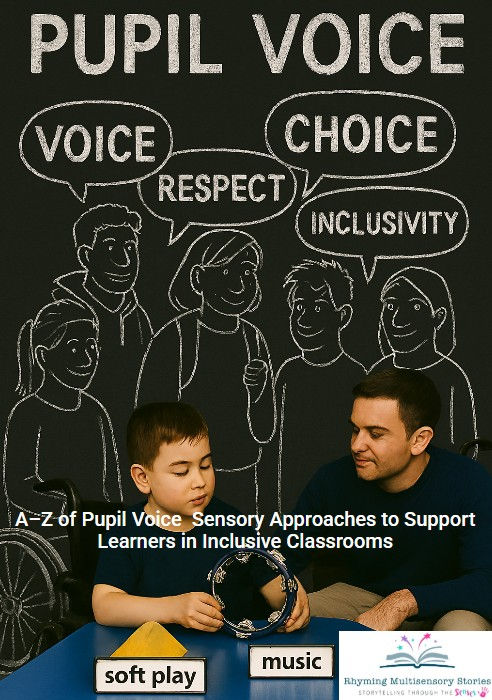
Just released!
Pupil voice refers to the meaningful involvement of learners in expressing preferences, making choices, influencing decisions, and shaping their educational experience. For some learners with PMLD and SEND, pupil voice includes:
• Eye gaze
• Facial expressions
• Body movements
• Vocalisations
• Gestures
• Sensory preferences
• Behaviour as communication
• Patterns of engagement or withdrawal
Pupil voice is not dependent on speech or symbolic communication. It is about recognising all forms of expression and ensuring that learners have opportunities to influence:
• Activities
• Routines
• Environments
• Interactions
• Resources
• Sensory experiences
• Transitions
• Daily choices
This resource provides practical, accessible ways to embed pupil voice into everyday practice.
Every learner communicates. Every learner expresses preferences, makes choices, and shows us what matters to them. For some some learners, communication may not be spoken, symbolic, or conventional — but it is always present, meaningful, and must be recognised.
Pupil voice is not about asking questions and waiting for words. It is about noticing, interpreting, responding, and shaping environments where every learner can influence their world. This book was created to support practitioners, teachers, support staff, therapists, and families in honouring the voices of learners who communicate through movement, expression, sensory engagement, and behaviour.
Grounded in the UK legal and policy context, the book reflects the expectations set out in the SEND Code of Practice, the Equality Act 2010, and the wider rights-based framework that places pupil voice at the heart of inclusive education. It supports practitioners to meet their statutory duties while honouring each learner’s autonomy, agency, and emotional safety. The guidance aligns with best practice across specialist settings, offering practical ways to embed pupil voice within everyday routines, sensory experiences, and personalised communication systems.
This A–Z collection offers simple, sensory aware activities that help practitioners notice, interpret, and respond to the many ways learners with PMLD and SEND communicate. Each activity focuses on a different cue, action, or sensory behaviour, giving clear guidance on what to look for, how to support it, and how to build it into everyday practice. The aim is to make pupil voice visible, valued, and woven gently into routines, interactions, and learning moments across the day.
Other Resources for April

Explore the fascinating world of minibeasts with this immersive, hands-on learning experience aimed at sensory learners of all ages created to spark imagination and exploration through interactive storytelling, sensory activities, and explorations.
Includes
A fully resourced, step‑by‑step sensory story and facilitation guide helping you deliver meaningful, accessible learning experiences with confidence.
Learning objectives to support planning, differentiation, and assessment
Sensory‑rich invitations bring each creature to life, including:
Wriggly Worm Sensory Tray Activity Invite learners to explore textures, movement, and cause‑and‑effect through hands‑on, wriggly play.
Minibeast Sensory Bottle Offer a calming, visual exploration that supports tracking skills and sustained attention.
A Bee’s Journey – Pollen Collecting Activity Encourage purposeful movement as learners collect and transfer “pollen,” building coordination and imaginative engagement.
Spider’s Web Weaving Activity Support fine‑motor development as learners weave threads to create their own intricate spider webs.
Group Hula Hoop Web Making Foster teamwork and communication as the group collaborates to build a giant shared web.
Moth‑Eaten Cloth and Torch Exploration Create a magical light‑and‑shadow experience that invites curiosity and visual tracking.
Woodlice Hunt Sensory Bin Promote investigative skills as learners search, sift, and discover hidden woodlice within the sensory bin.
The Minibeast Orchestra – Recreate Minibeast Sounds Explore rhythm, sound‑making, and expressive communication as learners recreate the noises of different minibeasts.
Soil Superheroes – Create a Wormery Support scientific thinking as learners observe how worms move, mix, and transform the soil.
Full List of Titles
Seasons
Spring
Summer
Autumn
Winter
A Winter Walk
January Through the Senses
The Weather
Culture & Celebrations
A Train Ride Through India
Book Day
Bonfire Night
Burns Night
Chinese New Year
Diwali
Halloween
Harvest Festival
Holi
Ramadan
The Witch
Antibullying
Back to School
Circle Time An A to Z of Sensory Approaches
Jobs and Work Experience
People Who Help Us – The Special School Superheroes
Pupil Voice An A to Z of Sensory Approaches for PMLD and SEND Learners in Inclusive Classrooms
The Dentist
Washing Hands
RE
The Easter Story
Sensory Saints
St Patrick’s Day
Maths
Shapes – A Multisensory Exploration
Topics and Themes
Airports and Airplanes
Elephants
Journey into Space
Minibeasts
The Beach
The Farm
The Rainforest
History
Benjamin Franklin
The King’s Coronation
The Queens Jubilee
The Great Fire of London
The Romans
VE Day
Reference
Listen – An A-Z of Sensory Inspiration to Stimulate the Auditory System
Sensory Bottles
Sensory Resources for Sensory Learners (800+ Ideas)
Christmas
Dear Santa (Includes How to Adapt into a Play)
Rudolph’s Carrots
Traditional Tales
Goldilocks and the Three Bears
Jack and the Beanstalk
Little Red Riding Hood
The Gingerbread Man
The Three Little Pigs

Find out more
Training and Workshops
'Multisensory Storytelling & Engagement Through Sensory Activities' Workshop

Find out more about Training and Workshops

Find out more about Online CPD Modules
Health & Safety Guidance
Please read before engaging in any of the activities
The author has taken care in preparing the information provided on this website and within all multisensory stories and resources. However, no representation or warranty is made regarding the accuracy, applicability, fitness, or completeness of the content.
All information is intended for pleasure and educational purposes only. If you choose to apply any ideas or activities described in this blog, on the website, or within any multisensory stories or resources, you do so entirely at your own discretion and assume full responsibility for your actions.
Supervision
All activities must be led and supervised by a responsible adult at all times.
The sensory explorer should be invited to participate freely, without expectation.
Never force engagement. Stop immediately if the person shows signs of discomfort or lack of enjoyment.
Allergies & Intolerances
If you have any doubts about an activity or prop, seek professional advice before starting.
Always check ingredients and materials for potential food, skin, or respiratory allergies.
Watch carefully for any signs of reaction (e.g., redness, swelling, breathing difficulties). If symptoms occur, seek immediate medical advice.
Safety Considerations
Be aware of potential choking hazards with small items or props.
Ensure all materials are safe, age‑appropriate, and suitable for the individual’s needs.
Adapt activities thoughtfully to respect the sensory explorer’s comfort, dignity, and wellbeing.
Your questions, queries, comments, and feedback are always welcome!
Get in touch: rhymingmultisensorystories@outlook.com
See you in May
Victoria:)


Very nice post